I read The Overstory between Christmas and New Year’s of 2024. It gave me weirder dreams than any drug I have ever taken, and I say that as someone with a small amount of relevant experience.
It also made me angry in a way I couldn’t name for about six months. This is my attempt to name it.
First, the part where I embarrassed myself
In March of last year, I went for a walk at the Missouri Botanical Garden. It was one of those perfect days, and I was counting them, because I knew I was about to move most of my life to Indiana.
I walked past the Linnean House and there was a conifer about eight feet tall, tucked next to the Wollemi pine, with a little label that said monkey puzzle tree.
I lost my mind. I have eleven monkey puzzle seedlings in West Lafayette. I have been reading about this species obsessively for two years. I had no idea the Garden had one. I told a group of complete strangers walking past that this tree is sacred to the Pehuenche—the name means “people of the pewen”—that they have eaten its seeds for thousands of years, and that a single tree can live twelve hundred years. I was grinning like an idiot. I found a volunteer on their way out and told them, politely, that their sign had the wrong species and the wrong continent, because this is Araucaria araucana and it comes from Chile and Argentina, not New Caledonia.
Then I bought a seven-dollar bottle of water and got in my car and something started nagging at me.
It wasn’t spiny enough.
My seedlings are little armored monsters. Every leaf is a blade. You do not casually brush against a monkey puzzle tree. This thing had looked soft.
So I emailed the Garden. And a horticulturist named Daria wrote back and explained, kindly and at length, that the tree is Araucaria scopulorum—a real species, endemic to New Caledonia, endangered because of mining on the island. That there are about twenty species in the genus, spread across South America, eastern Australia, and New Caledonia. And that “monkey puzzle” is a common name, which means it is not standardized, which means it can be hung on more than one species.
The label was right. The location was right. The species was right.
I was the one who was wrong, and I was wrong in a very particular way. I didn’t misread the sign. I read the part of it that was loose—the common name—filled in the rest from memory, and went looking for someone to correct.
I was annoyed for about a day. I now realize I had just been handed the exact thing my novel is about, for free, by a botanical garden I’ve been a member of since 2009. Because that is exactly how memory and history work: the durable signal survives, but the precision falls off in transit.
Which is not to say the Garden is always right. A few months later I went into their home gardening building to ask about potting soil for my seedlings, and got told that pot depth didn’t much matter because these trees don’t have a taproot.
They absolutely have a taproot. It’s one of the first things a pewen seedling does—it sends a root straight down, hard, before it does much of anything else. It’s why you can’t grow one in a shallow pot and why mine live in tall ones. I didn’t push it. You don’t win that argument standing in a home gardening center. But I’ve thought about it a lot since, because three of my trees died in the year after that conversation and pot depth wasn’t why, and I would have liked to have been talking with someone who was willing to be told something.
I tell you all of this because everything I’m about to say about Richard Powers should be read by someone who knows I do this.
What The Overstory does extraordinarily well
The Overstory won the Pulitzer and it earned it. The prose is extraordinary. It took the mycorrhizal research—Suzanne Simard’s work, the “wood wide web”—and turned it into something that changed how a lot of people walk past a tree. That’s not nothing. That’s the thing novels are supposed to do and almost never manage.
And it sent me down a rabbit hole I’m still in. I went and read actual papers about endo- versus ectomycorrhizal fungi. I got interested in the fact that plants have organs, just primitive ones. I did fine in botany in school and had forgotten all of it, and this book made me go back.
So the criticism that follows comes from someone who read it three times.
The forest is not a family
Here’s the thing that took me almost two years to name.
Powers wrote a romance about trees.
The forest in The Overstory is a community. There are mother trees. There’s nurturing, sharing, warning, conversation. Trees look out for their kin. The network is a network of care.
And look—the science on that is more contested than the popular version suggests. There’s real published pushback on the mother-tree framing, on how much of the “trees talk to each other” story survives careful replication. But that’s not actually my objection, because I don’t think Powers was writing a paper.
My objection is that it’s a projection. We looked at an enormous alien system we barely understand and we decided it was a family, because we are a species that finds families comforting.
What if it isn’t?
In my own novel, my main character Emma falls into this exact trap. She merges with the fungal network and immediately decides the forest is a “ledger.” But she only thinks that because she is a caregiver traumatized by insurance companies; she projects invoices onto the trees because merciless math is the only language she has left.
But the forest isn’t actually doing math. It isn’t balancing accounts, recording who took what, or holding grudges. It is retention without a rememberer.
It is a tally of intensity. Think about signing yourself out of a nursing home. The institution isn’t going to remember the exact time you wrote on the sign-out sheet. But if you shout at the top of your lungs about how you’re finally leaving while you walk down the hall, the whole floor remembers the exit. Or think about my cockatoos. When it’s bedtime, they don’t care about the precise vocabulary I use to say goodnight. They care that I make a big, loud, repetitive deal out of it, because the energy and the repetition are what actually land.
The forest keeps whatever gets repeated loudly and loses most of whatever gets specified. I don’t think that trees are the kind of things that have a because. Nutrients move. Signals route. A feeling sent with enough energy persists, a whispered detail dissolves, and none of it means anything personal to the system doing it.
That’s not less beautiful to me. It’s more. Or maybe I am projecting as the lifelong companion to a 26 year old cockatoo that I’ve had since I was 20.
What about the other 75%?
Powers makes a lot of the fact that we share about a quarter of our DNA with trees. Kindred, see? Cousins.
I keep getting stuck on the other three-quarters.
We share a quarter. Fine. What is the other seventy-five percent doing? Because whatever it is, it’s building something that eats light, drinks through its feet, has sex via insects, can’t move, can’t run, can’t decide, and can keep doing all of it for twelve hundred years while entire human civilizations rise and collapse underneath it.
Monkey puzzle trees were here before the flowering plants. They watched the dinosaurs happen. A single individual can outlive the Roman Empire’s entire run, twice.
I don’t think that’s a cousin. I think that’s an alien that happens to use some of the same chemistry.
And I say this as someone who lives with three cockatoos. My birds will likely outlive me. I’ve had a deep relationship with an animal on a different timescale than mine for most of my adult life, and I’ll tell you what I’ve learned from it: the respect goes further when you stop insisting they’re like you. My birds aren’t my kids. I love them ferociously and they are wild animals I have tamed and they think in ways I will never have access to. That’s not a downgrade. That’s the whole interesting part.
I want trees to get the same courtesy. Let them be aliens.
The part of The Overstory that actually pisses me off
Here’s my sharpest complaint, and it’s not about biology.
The Overstory is populated by people who sit in trees. Who give years to activism. Who tie themselves to things.
Who is paying for that?
I am genuinely asking. How are these people making rent? Can you take three months off your job to go live in a redwood? Six? Most people I know are working one job and thinking about picking up a second, and that math has gotten worse every year since the book came out, not better.
The people out there doing the dramatic stuff are getting attention, and the attention is good, and they are also—overwhelmingly—people with the resources to disappear from the economy for a while. That’s a class of person. The book doesn’t examine it. It just quietly assumes it.
I say this as a woman who can pass for comfortably middle class now, and who started taking classes at Ozarks Technical Community College in 1995, having just turned fifteen. A few at a time, not full time. One of them was a computer tech class I took sitting next to my dad, where I learned DOS.
So what’s left for the rest of us?
Small shit. Unglamorous, consistent, small shit. When we had landscaping planned for the yard in Indiana, the plan came back from a highly referred local guy with boxwood in it. Boxwood. In 2025. Along with a few other things I won’t itemize, and no apparent awareness that native planting is a thing people do on purpose.
So I put my foot down: Indiana natives only, and zero herbicide, because it all drains into a stream eventually. That was agreed to without much fuss, which tells you the boxwood wasn’t a conviction, it was a default. It’s what the good ol’ boy with the truck puts in because it’s what he’s always put in.
That’s the whole rebellion. Refuse the default. Skip the fake green carpet everybody thinks they’re supposed to have—the ordinance around here only cares if you’re over ten inches. And when the neighbors notice you’re not spraying, sometimes they stop spraying.
Nobody writes a novel about that. Maybe somebody should.
The question The Overstory left in my head
Okay. Here’s where the book I wrote came from.
Sometime around 2020 I had a tree dream after reading Powers, and it stuck to me for years. Then, much later, I took psilocybin mushrooms for the first time, and afterward I made a voice note that I still have.
The question in it was this: what if we could go the other direction?
Not what if trees talk to each other—what if we could get in. And what if the way in was the fungus.
Because here’s the setup that will not leave me alone. Psilocybin mushrooms grow in soil. Soil is full of fungal networks. Those networks are physically entangled with tree roots, trading with them, moving things back and forth. And psilocybin, whatever else it does, unambiguously does something to human perception. The explanation that makes the most sense to me is the filtering one—it’s not adding anything, it’s taking the filters off, letting you see patterns that were always there.
So: what if you engineered it? Not for recreation. For translation.
What if a fungus could be built to sit between two incompatible systems and make them interoperable—to compress tree time down to the scale a human brain can hold? Four hundred years into forty minutes. Not a hallucination. A codec.
That’s not so far from how people describe a trip already. Time going strange, scale collapsing, boundaries thinning. What if that were intentional and aimed?
And if you could do that—if you could ask the forest a question—what would you find in there?
I don’t think you’d find a mother tree. I think you’d find a badly maintained archive that kept whatever people said loudly and often, and lost everything precise. I think you’d find gossip. I think you’d find that the most durable storage medium on Earth is repetition, and that repetition is terrible at numbers.
So I wrote Hold Without Taking
Hold Without Taking is out October 15.
A mother in 1998 with a nine-year-old son who has Duchenne muscular dystrophy hides a wish inside a broken line of HTML, and wakes up in a forest where there are no roads, no engines, and no people. What she finds there is not a laboratory. It’s an archive that can tell her a treatment exists and cannot tell her the dose.
The trees in it are characters, same as in Powers. But they’re allowed to be the aliens they actually are. They don’t love her back. They don’t love anything. They keep what gets repeated and they don’t know they’re doing it, and somehow that turned out to be enough.
If any of this is your kind of thing, I’m looking for advance readers. Free copy, free audiobook if you’d rather listen, honest review when it comes out. Sign up below or here.
And if you’re ever at the Missouri Botanical Garden, go find the tree in the Linnean House, next to the Wollemi pine. The sign says monkey puzzle. The sign is correct. It is also not the tree you’re picturing, and neither was the one I was picturing, and somewhere in between those two facts is the whole reason I spent two years writing a book.
Names travel further than the things they’re attached to. That’s the problem, and it’s also the only reason any of this survives at all.
Advance Readers Wanted
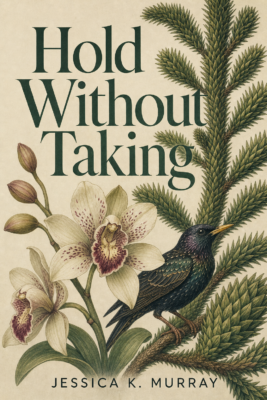
I spent three years growing monkey puzzle trees, and somewhere in there I wrote a novel with one of them in it. Hold Without Taking is out October 15. It's about a mother, a fatal childhood disease, and a monkey puzzle tree standing in a forest with no people left in it. I'm looking for advance readers — free copy, honest review on Amazon.
Sign up below:
Thanks!
P.S. A note on transparency:
Earlier, I mentioned that we should let alien systems be aliens rather than projecting our own familiar comforts onto them. I put my money where my mouth is with this book. Hold Without Taking was a massive, sometimes grueling experiment in human-AI collaboration.
I used BookyAI (connected to the Fable API) for the drafting and the cover generation, and I wrangled Gemini, ChatGPT, Claude, and Google to help me with fact-checking, continuity, and copy editing. (Even this essay was shaped with AI from my own voice notes.) I wrote a script to check the math: About 62% of the sentences in the finished book appear word-for-word in the original machine draft. That’s not the same as saying the book is 62% AI — I read and decided on every sentence, including the ones I chose to keep. But it’s the honest number, and I’d rather publish it than a flattering one.
Here’s the part that surprised me. The chapters I rewrote hardest came back at 16–22%. The ones I left mostly alone came back at 81–87%. And the chapters my beta readers independently flagged as “reading like a TED talk” were, every single time, the highest-carryover chapters in the book. The machine’s fingerprint isn’t bad prose. It’s fluent, thesis-forward, explanatory prose that sounds competent enough that you don’t flag it on a read-through.
If you hear that number and conclude the machine wrote it, I’d ask which 62% you think I should have retyped to make it mine. This wasn’t a magic button; it was a wrestling match. I spent over forty hours prompting, breaking things, revising, and arguing with language models to force this story into the exact shape it needed to hold. It turns out that steering a generative system takes the same kind of unglamorous, consistent, small-shit labor as pulling invasive species out of a yard.
I’m putting together a full case study on how this process actually works—and the messy, exhausting reality of doing it right. Keep an eye out for that soon.
0 Comments